
We all worship shiva one way or the other and experience his energy in a particular form or an avatar. Either by visiting a certain temple or What if worshipping Lord Shiva was not limited to seeing him in an image, or a temple?
What if the Sun that illuminates your morning, the Moon that cools the night, the air entering your lungs, the water sustaining your body, the fire transforming matter, the Earth supporting your every step, and the space surrounding you were all ways of experiencing Shiva?
This is the profound spiritual vision contained within the Ashtamurti Stava, the sacred praise offered by Shukracharya to Lord Shiva.
The Stava is connected with the remarkable story of Shukracharya's tapasya and his attainment of Mrita Sanjivani Vidya, the extraordinary knowledge associated with restoring life to the dead.
But the deeper teaching of the Ashtamurti Stava goes far beyond receiving a boon. It teaches us how to recognize Shiva everywhere. You are wondering what is this "Ashtamurti Stava"?
Let's understand who Shukracharya was? Known as Daitya Guru. Shukracharya was born into the lineage of the great Maharishi Bhrigu and became renowned as a great devotee of Lord Shiva.
According to the Shri Shiva Mahapurana, Shukracharya came to the sacred city of Kashi and established a Shiva Linga that became known as Shukreshwar. There, while meditating upon Lord Vishwanath, he performed severe tapasya for an extended period. His austerities were so intense that Lord Shiva, pleased with his devotion, manifested before him from the Shiva Linga. You can imagine the spiritual intensity of that moment. The deity whom Shukracharya had worshipped through prolonged discipline and surrender was now directly before him.
Overwhelmed with devotion, Shukracharya praised Shiva through the hymn known as the Ashtamurti Stava, also called the Murtyashtaka Stotra.
Lord Mrityunjaya was pleased with his devotion and eventually bestowed upon Shukracharya the extraordinary Sanjivani Vidya.
What is Ashtamurti Stava?
What does Ashtamurti mean? Ashta means eight. Murti means form or manifestation. Ashtamurti therefore refers to the eight manifestations of Shiva. The Stava teaches us to contemplate Shiva through:
Earth
Water
Fire
Air
Space
The Inner Self
Moon
Sun
These manifestations are associated with the eight forms of Shiva known as:
Sharva, Bhava, Rudra, Ugra, Bhima, Pashupati, Mahadeva and Ishana.
This immediately changes how we understand Shiva worship. Creation itself becomes his manifestation. The Ashtamurti Stava gradually takes our consciousness through these manifestations until we arrive at its deepest teaching: the Shiva we are searching for outside is also present as the Antaryamin (Soul-Self), the indwelling divine presence within all beings.
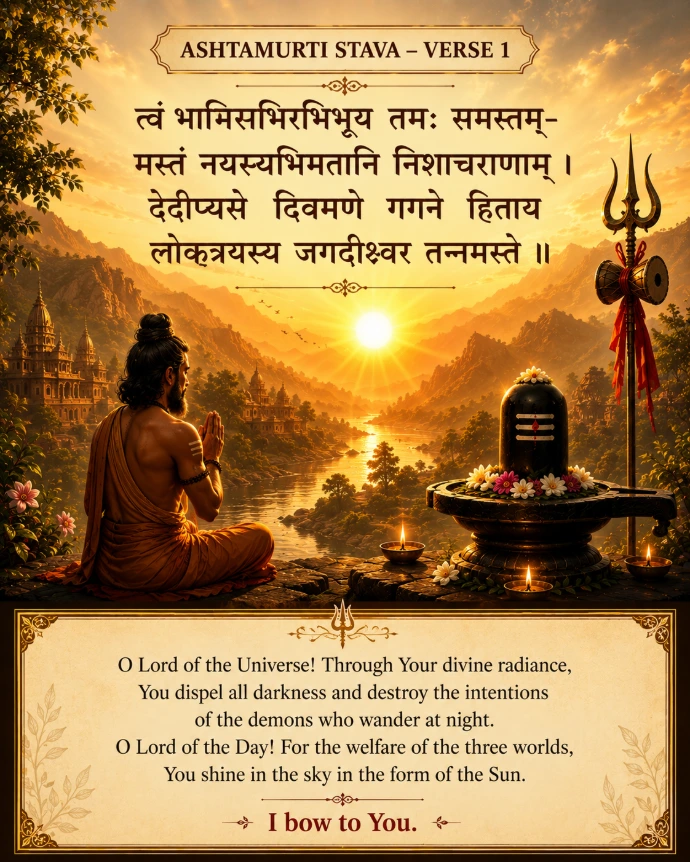
Verse 1
Shiva as the Sun- The Power of Illumination
Shukracharya first recognizes Shiva through the brilliance of the Sun. He praises the Lord whose radiance removes darkness and who shines in the heavens for the welfare of the three worlds. At the surface level, the imagery is solar. At the spiritual level, however, darkness can also represent ajnana—ignorance.
We suffer when we cannot see clearly. We repeat patterns because we cannot recognize them. We remain confused because we cannot distinguish truth from projection. When light enters, what was hidden becomes visible.
This is the spiritual function of Shiva as the Sun.
Benefits of Reciting Verse 1
You can recite just this to gain clarity, confidence, vitality, direction and removal of inner darkness.
When you feel confused about your path, contemplate Shiva not simply as someone who will give you the answer, but as the consciousness that allows you to see the truth clearly.
Verse 2
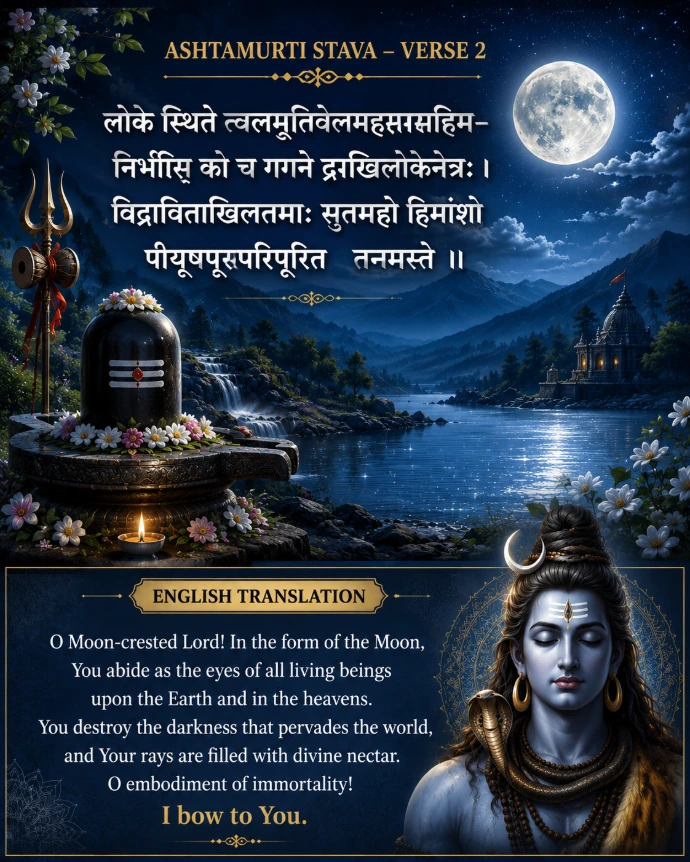
Shiva as the Moon - The Power of Nourishment
After experiencing Shiva as the brilliance of the Sun, Shukracharya recognizes him through the cooling and nourishing presence of the Moon. The verse here describes the Moon as the eye of living beings and speaks of its nectar-filled rays.
There is a beautiful balance here. The Sun illuminates. The Moon soothes. Not every transformation requires more fire. Sometimes consciousness needs cooling. Sometimes the mind needs rest. Sometimes healing begins not through action but through becoming receptive again.
Benefit of Reciting Verse 2
You can recite this verse to gain emotional peace, mental calm, nourishment, receptivity and restoration. When your emotional world feels overheated or restless, this verse reminds you of Shiva's gentler manifestation.
The same Shiva who burns impurities through fire also appears as Soma the cooling, replenishing principle.
Verse 3
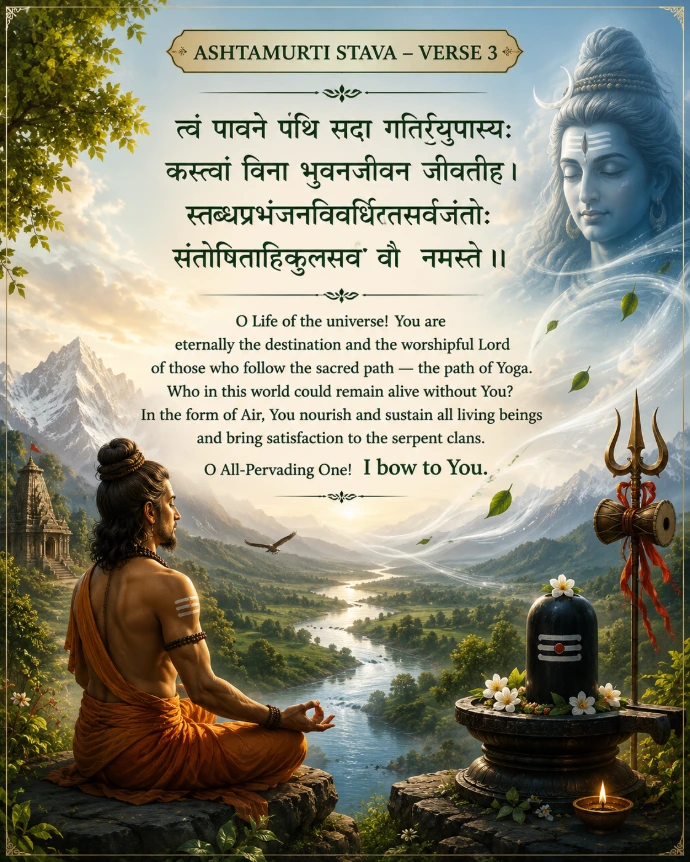
Shiva as Air — The Force That Sustains Life
In the third verse, Shiva is recognized through Vayu—Air.
Shukracharya asks a simple but profound question: Without this life-sustaining force, who could remain alive? We rarely notice our breath when everything is going well. Yet breathing is happening continuously. Life is being sustained moment after moment without our conscious command. Vayu therefore becomes much more than physical air. It points toward Prana—the movement of life-force.
Benefit of Reciting Verse 3
Recite this verse for movement, vitality, life-force, expansion and release from stagnation. When life feels stuck, return to your breath. Notice that even when the mind says nothing is moving, life itself continues moving through you. Shiva is present in that movement.
Verse 4
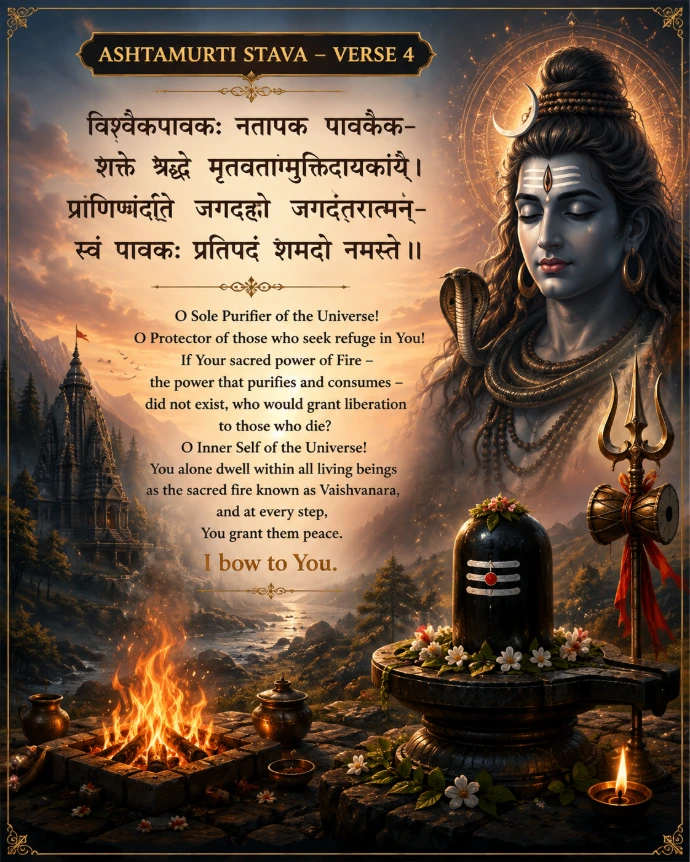
Shiva as Fire — The Power of Transformation
The fourth verse introduces one of Shiva's most recognizable principles: Fire. Shukracharya praises Shiva as the purifier and as the sacred fire dwelling within us. Fire has an extraordinary quality. Whatever enters fire cannot remain exactly as it was. Its form changes. This is why Agni becomes such a powerful spiritual symbol. Transformation requires something old to stop existing in its previous form. This is also why Shiva's relationship with destruction is frequently misunderstood. Shiva does not destroy merely for the sake of destruction. Shiva dissolves forms when transformation requires them to change.
Benefit of Reciting Verse 4
Recite this verse for: purification, transformation, courage to release the past and acceptance of necessary endings.
Ask yourself: What am I trying to preserve that transformation is asking me to release?
Sometimes the very ending we fear becomes the doorway to our next form.
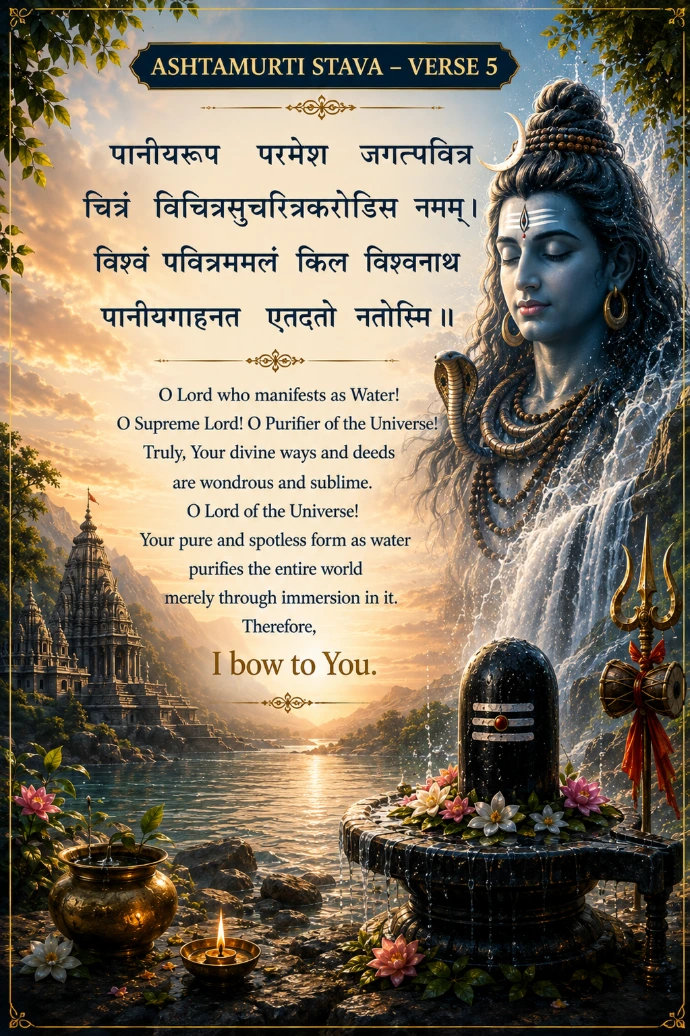
Verse 5
Shiva as Water - The Power of Purification
Shukracharya then recognizes Shiva as Jala- Water. This verse praises the pure form of water and its capacity to purify. Water carries another teaching. It flows. It cleanses. It nourishes. It adapts to the vessel containing it without losing its essential nature. This makes water a profound symbol for spiritual purification. Purification does not always mean fighting against something. Sometimes purification means allowing something to flow out of us.
Benefit of Reciting Verse 5
Recite this verse for cleansing, emotional renewal, purification and spiritual freshness. Use its teaching when you are carrying emotional residue from experiences that have already ended. Allow Shiva's water principle to remind you: You do not have to continue carrying everything you have experienced.
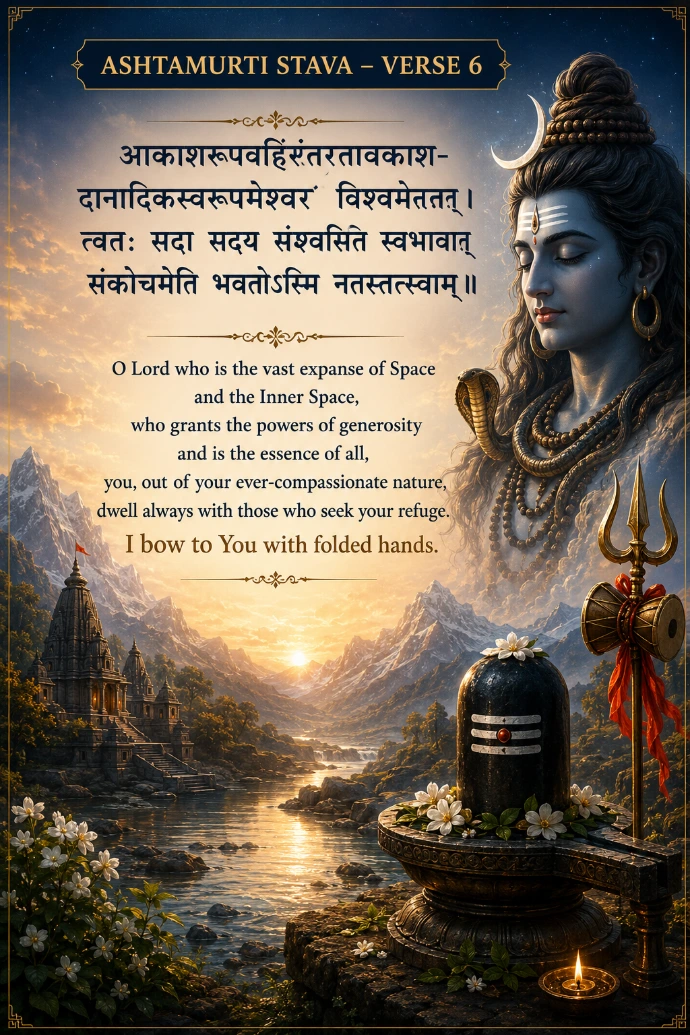
Verse 6
Shiva as Space - The Power of Expansion
Space is perhaps the most subtle of the five great elements. We notice objects. We rarely notice the space allowing those objects to exist. Yet without space, where could anything appear? The sixth verse recognizes Shiva as Akasha—the space within and outside creation. This carries an extraordinary spiritual teaching. Thoughts arise within awareness. Emotions arise within awareness. Experiences arise within awareness. Identities arise within awareness. And eventually, they pass. Yet the field in which they appeared remains.
Benefit of Reciting Verse 6
Recite this verse for mental spaciousness, freedom from constriction, expansion of consciousness and greater perspective. When your mind becomes consumed by one problem, remember Akasha. Your current experience exists within something much greater than itself. Create space around the problem before trying to solve it.
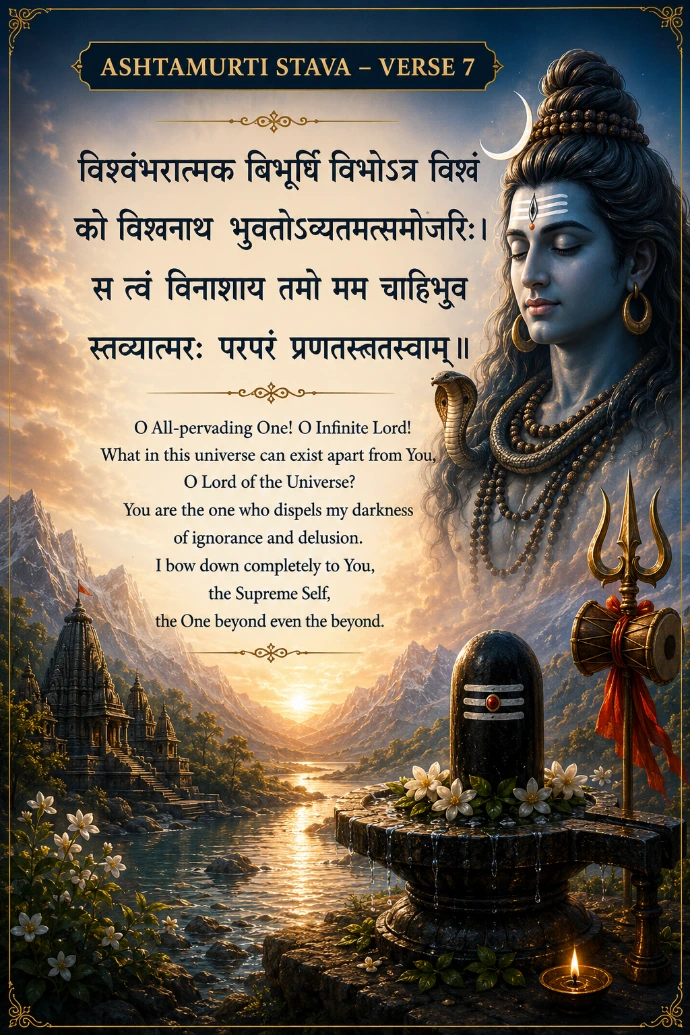
Verse 7
Shiva as Earth - The Power That Supports Us
Shiva is next contemplated as Prithvi- Earth, the sustaining foundation of embodied existence. Earth supports us continuously without asking whether we remember its presence. It gives stability to movement. It provides the ground upon which our physical lives unfold. Yet this verse also contains a deeply personal prayer. Shukracharya asks Shiva to remove the darkness of ignorance. This connects grounding with wisdom. Spiritual realization does not require abandoning the material world. The Earth itself can become a manifestation through which Shiva is recognized.
Benefit of Reciting Verse 7
Recite this verse for grounding, stability, support, nourishment and removal of ignorance. When your thoughts become scattered, return to what is real and present. Return to the ground beneath you. Return to your responsibilities. Return to the body. Return to the present moment. Sometimes spiritual clarity begins by becoming grounded.
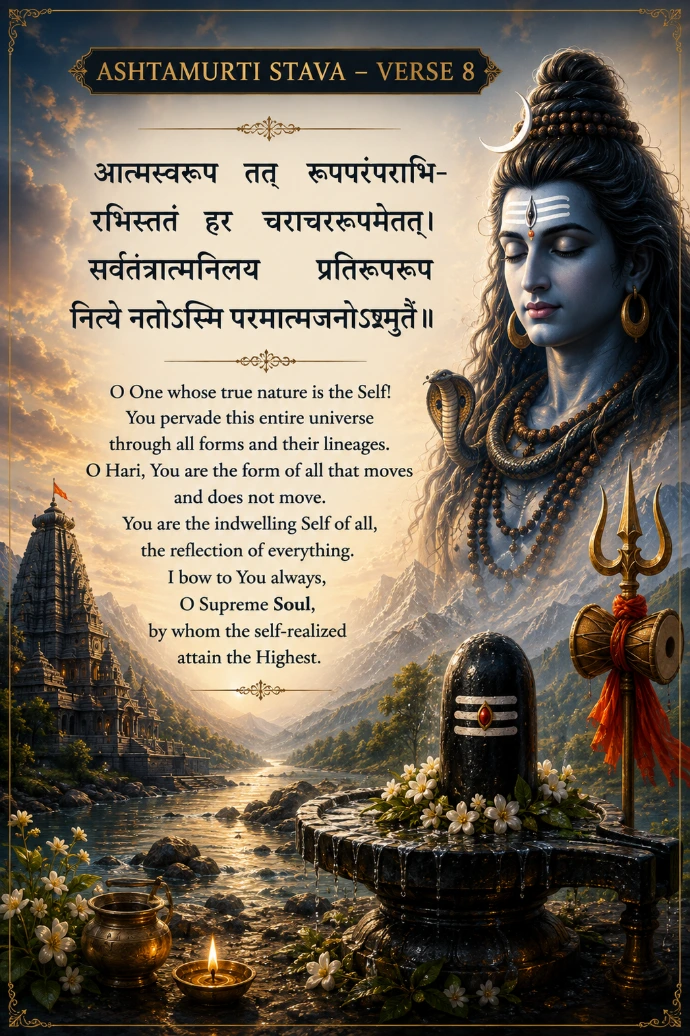
Verse 8
Shiva as the Inner Self — The Turning Point of the Stava
The eighth verse takes the teaching inward. Until now, we have been recognizing Shiva through creation. Sun, Moon, Air, Fire, Water, Space, Earth. But now Shukracharya recognizes Shiva as Atma-svarupa—the nature of the Self. This is the philosophical culmination of the Stava. If Shiva pervades everything, how could the one observing creation be excluded? The Divine we seek externally must also be recognized internally. This is where worship begins transforming into realization.
Benefit of Reciting Verse 8
Recite this verse for self-awareness, spiritual realization, inner connection and recognition of the Divine presence within yourself and others. Instead of asking only: “Where is Shiva?”
Begin asking: “Who is the consciousness experiencing this moment?”
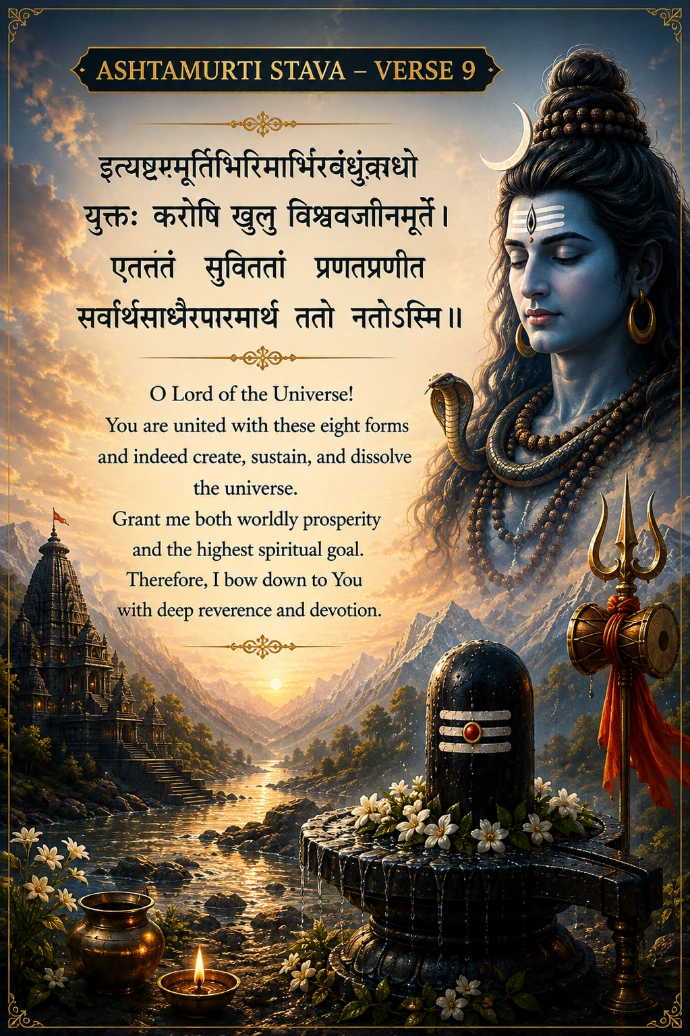
Verse 9
Shiva as the Totality of the Eight Forms
The final verse gathers everything together.
The eight manifestations are not eight separate Shivas.
They are eight ways of recognizing one Supreme Reality.
Creation is pervaded by Him.
The elements are His manifestations.
The cosmic forces are His manifestations.
The inner Self is His presence.
The journey therefore moves from multiplicity back toward unity.
Benefit of Reciting Verse 9
Recite this concluding verse for integration, surrender, meaningful worldly fulfillment and progress toward the highest spiritual purpose. The verse beautifully brings together two dimensions of human life: Artha—the purposes and necessities of worldly existence and Paramartha—the highest spiritual purpose. Spirituality therefore does not necessarily require rejecting worldly life. It asks us to understand worldly life from a higher perspective.
 The Ashtamurti Stava begins by showing us Shiva through creation. But it does not leave us there. It gradually removes the boundary between the worshipper, the world and the divine. Then you finally turn inward. This in itself is the greatest Sanjivani contained within the teaching. Not merely brining something dead back to life, but awakening our consciousness to the divine presence that was alive within and around us all along.
 Energy readings help reveal where your energy has become stagnant, depleted, or repeatedly tied to situations that no longer support your growth. By bringing these hidden patterns into awareness, you begin to recalibrate your energy, restore inner balance, and come back into alignment with your own consciousness.
Just as Shiva represents transformation and Sanjivani represents revival, an energy reading can help you recognize the "dead cycles" you keep repeating and understand what needs to end, shift, or be renewed. When your energy changes, your awareness changes and you create space for a more conscious version of yourself to emerge.
Aum Namah Shivaya.